
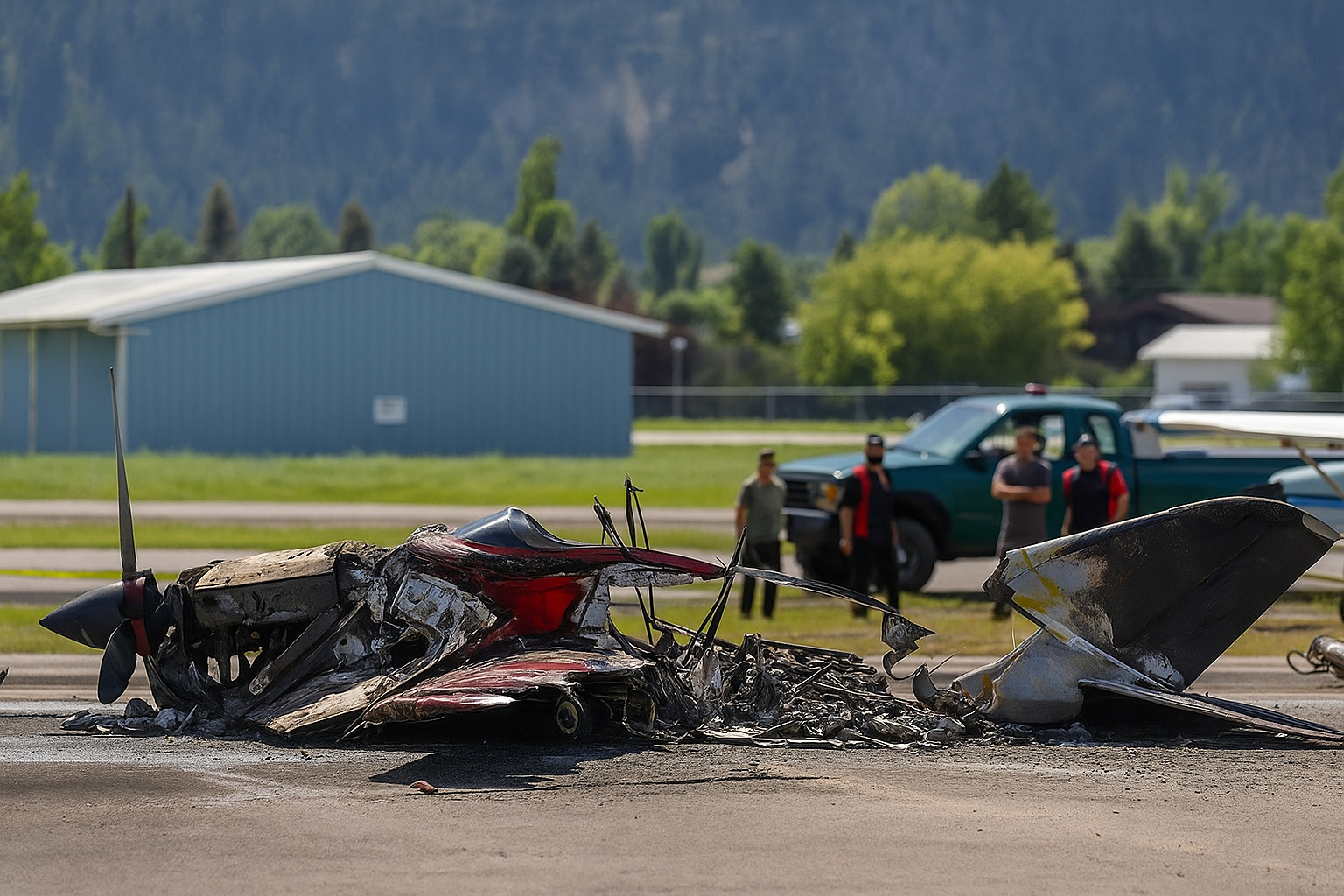
On August 11, 2025, at around 2:00 p.m. local time, a Socata TBM 700 turboprop carrying four people crashed while attempting to land at Kalispell City Airport in Montana. The aircraft veered off course during touchdown and struck multiple parked planes, triggering a massive fireball that engulfed parts of the runway and nearby grassy areas. Thick black smoke was visible for miles as emergency crews rushed to the scene. Remarkably, all four occupants escaped without life-threatening injuries—two sustained minor wounds and were treated on-site. The blaze was contained within minutes by firefighters using foam and water, preventing further spread. The FAA and NTSB have launched a joint investigation to determine the cause of the incident.
Location & Airport Context
Kalispell City Airport (S27) serves general aviation south of downtown Kalispell in Flathead County, Montana. The facility supports small aircraft operations, flight training, and regional business travel. Runway-adjacent tie‑down and parking areas place parked aircraft in proximity to active movement areas, which can elevate risk during off‑nominal arrivals or runway excursions.
Aircraft & Flight Information
The aircraft involved is reported as a Socata TBM 700 (single‑engine, pressurized turboprop). Media reports indicate the aircraft was built in 2011 and registered to Meter Sky LLC of Pullman, Washington. The arrival originated in Pullman and was on approach to Kalispell at the time of the accident. Turboprop singles like the TBM family are known for high approach speeds relative to piston singles, which can reduce margins during landing if any instability, mechanical issue, or runway condition arises.
Occupants & Injuries
Four individuals were aboard the aircraft (pilot and three passengers). All four escaped without life‑threatening injuries. Authorities and multiple outlets reported two minor injuries treated on scene; no fatalities have been reported. There were no occupants in the parked aircraft that were struck.
Fire Behavior & Emergency Response
Impact with parked aircraft led to a rapid post‑crash fire, producing a pronounced fireball and dense black smoke. Fuel from the aircraft and potentially from impacted airframes contributed to the intensity. Airport crews and municipal firefighters executed an aggressive attack using foam to smother fuel‑fed flames and water for cooling adjacent surfaces. Containment was achieved within minutes, preventing spread into larger facilities or off‑airport property. Operations were paused to allow responders to secure the scene and conduct initial safety checks.
Damage Assessment (Preliminary)
Visual evidence and agency statements indicate substantial damage to the arriving aircraft and varying levels of damage to multiple parked aircraft. Heat exposure and flame impingement likely compromised composite structures, wiring, and avionics on affected airframes. A full assessment by owners, insurers, and maintenance providers will determine repairability versus total loss. Runway and taxiway surfaces will require inspection for spalling, rubber deposits, and potential FOD from composite and metal debris.
Eyewitness Accounts & Media
Witnesses described a thunderous impact followed by a fast‑moving wall of flame across a portion of the field. Numerous videos and photos shared on social media and local outlets show the fireball and subsequent smoke column. These accounts corroborate the rapid onset of a post‑impact fire and the quick suppression efforts by fire crews.
Weather & Environmental Factors (Pending Confirmation)
As of this writing, specific weather details (wind, visibility, ceiling, temperature) at the exact time of the crash have not been formally released in investigative documents. Local reports have not attributed the event to adverse weather. Final analysis will incorporate METAR/TAF data and any localized effects (e.g., gusts or density altitude) relevant to approach and landing performance.
Regulatory & Investigative Status
The Federal Aviation Administration (FAA) and National Transportation Safety Board (NTSB) are investigating. Preliminary statements indicate loss of control on landing, with additional local reporting citing possible engine trouble before impact. The NTSB typically issues a preliminary report within days, followed by a more detailed factual report. A probable cause statement may take several months, addressing mechanical, human factors, and environmental contributors.
Safety Considerations & Lessons
1) Stabilized Approach: High‑performance singles require tight adherence to stabilized approach criteria. Unstable energy state or high sink rate near touchdown can lead to runway excursions.
2) Emergency Egress: Prompt self‑evacuation by all four occupants likely reduced injury severity; regular briefing of exits and actions is critical.
3) ARFF Coordination: Rapid foam application and hot‑spot control limited fire spread across aircraft parking areas.
4) Airport Layout: Proximity of tied‑down aircraft to active surfaces is common at general aviation fields; markings, barriers, and procedural mitigations can reduce exposure.
5) Maintenance & Pre‑Landing Checks: If engine anomalies are confirmed, powerplant health monitoring and decision‑making (e.g., go‑around) will be key topics in the final report.
Key Open Questions
- Was there a confirmed mechanical issue (e.g., engine power loss) prior to touchdown?
• What were the exact approach speeds, configuration, and touchdown parameters?
• Did runway conditions or winds contribute to loss of directional control?
• What were the exact fuel quantities and potential sources that fed the post‑impact fire?
• Are there recommended procedural changes for parking or movement areas at the airport to reduce exposure?
Conclusion
The Kalispell City Airport crash underscores how quickly a routine landing can escalate when control is lost near the ground, particularly at fields where parked aircraft are adjacent to active movement areas. Rapid evacuation by occupants and decisive action by responders kept this dramatic incident from becoming a mass‑casualty event. Definitive answers will come from the FAA/NTSB investigation, which will clarify whether human factors, mechanical anomalies, or environmental conditions—or a combination—drove the sequence of events. In the meantime, operators and airports can revisit stabilized approach discipline, emergency egress readiness, and ramp‑area risk mitigations.


