
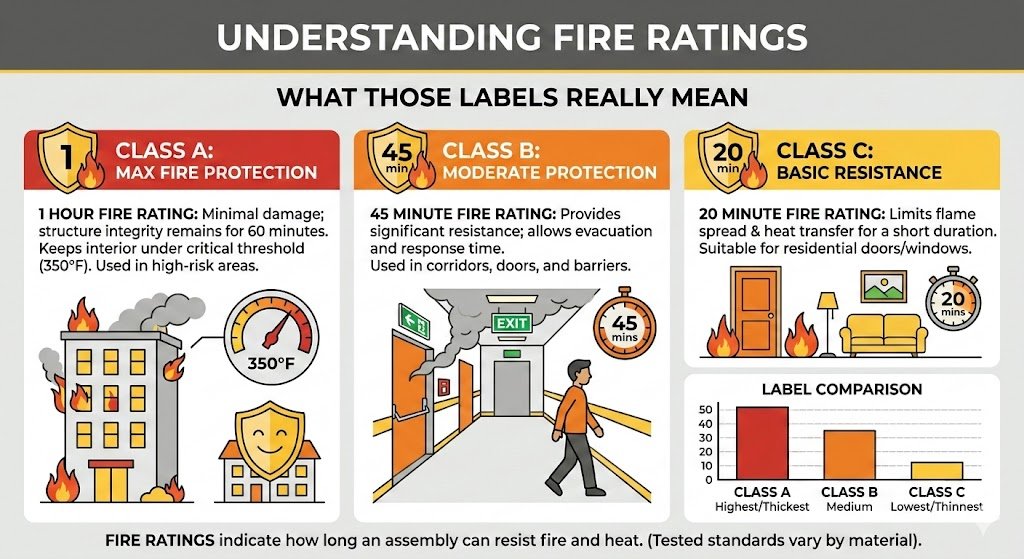
When you see labels on doors, walls, cables, or structural elements, they often mention Fire ratings, but many people don’t fully understand what those numbers and terms actually indicate. Fire ratings are not marketing buzzwords—they are tested performance indicators that show how long a material or system can withstand fire under controlled conditions. For building owners, safety managers, and facility teams, understanding Fire ratings is essential for making informed decisions that protect lives and property.
What Are Fire Ratings?
Fire ratings define how long a building element can resist fire exposure before it fails. These ratings are determined through standardized fire tests conducted in laboratories. The result is usually expressed in time—such as 30, 60, 90, or 120 minutes—indicating how long the element can perform its intended function during a fire.
This performance may include:
-
Maintaining structural stability
-
Preventing the spread of flames
-
Limiting heat transfer to adjacent spaces
In practical terms, fire ratings help slow down fire growth, allowing occupants more time to evacuate and firefighters more time to respond.
How Fire Resistance Is Measured
The Fire resistance rating of a component is established by exposing it to a controlled fire that follows a standard time–temperature curve. During testing, engineers monitor how the material behaves under extreme heat and pressure.
A fire-resistant assembly is evaluated on three main criteria:
-
Integrity – whether flames or hot gases pass through
-
Insulation – how well heat transfer is restricted
-
Stability – whether the element remains structurally sound
If the assembly meets all required criteria for a specific duration, it earns a corresponding fire rating.
Understanding Fire Rating Classifications
Fire rating classifications help professionals quickly identify where and how a product or system should be used. These classifications are often linked to building components such as walls, floors, ceilings, doors, ducts, and cable trays.
Common examples include:
-
30-minute rating – Typically used in low-risk or small compartments
-
60-minute rating – Common in commercial buildings and corridors
-
90–120-minute rating – Required in high-risk areas, stairwells, and fire barriers
Each classification serves a specific purpose within a building’s fire safety design.
Fire-Rated Materials Explained
Fire-rated materials are specially engineered to resist ignition, limit flame spread, and maintain performance during a fire. These materials may be treated, layered, or designed as part of a tested assembly rather than used alone.
Typical fire-rated materials include:
-
Gypsum boards with fire-resistant cores
-
Fire-rated glass and glazing systems
-
Intumescent coatings that expand under heat
-
Fire-resistant cables and insulation
It’s important to note that a single material may not be fire-rated on its own unless it has been tested as part of a complete system.
The Role of Testing and Certification
Globally recognized testing bodies play a critical role in validating fire ratings. One of the most trusted organizations in this field is Underwriters Laboratories. Their UL fire rating standards ensure that products perform consistently under severe fire conditions.
Manufacturers submit products for testing, and only those that meet strict criteria are certified. This certification gives confidence to architects, consultants, and regulators that the product will perform as expected in real-world fire scenarios.
Why Fire Ratings Matter for Compliance
Fire ratings are not optional—they are closely tied to Building code fire requirements. National and local building codes specify minimum fire ratings for different occupancies, heights, and building uses.
Non-compliance can lead to:
-
Project approval delays
-
Legal penalties and insurance issues
-
Increased risk to occupants and assets
By selecting correctly rated systems, building owners ensure both regulatory compliance and enhanced life safety.
Common Misunderstandings About Fire Ratings
A frequent misconception is that higher fire ratings mean a building is “fireproof.” In reality, no structure is completely fireproof. Fire ratings are designed to delay fire spread, not eliminate it.
Another misunderstanding is assuming that replacing one component does not affect the rating. In fact, changing even a small part of a tested assembly can void its certified performance.


