
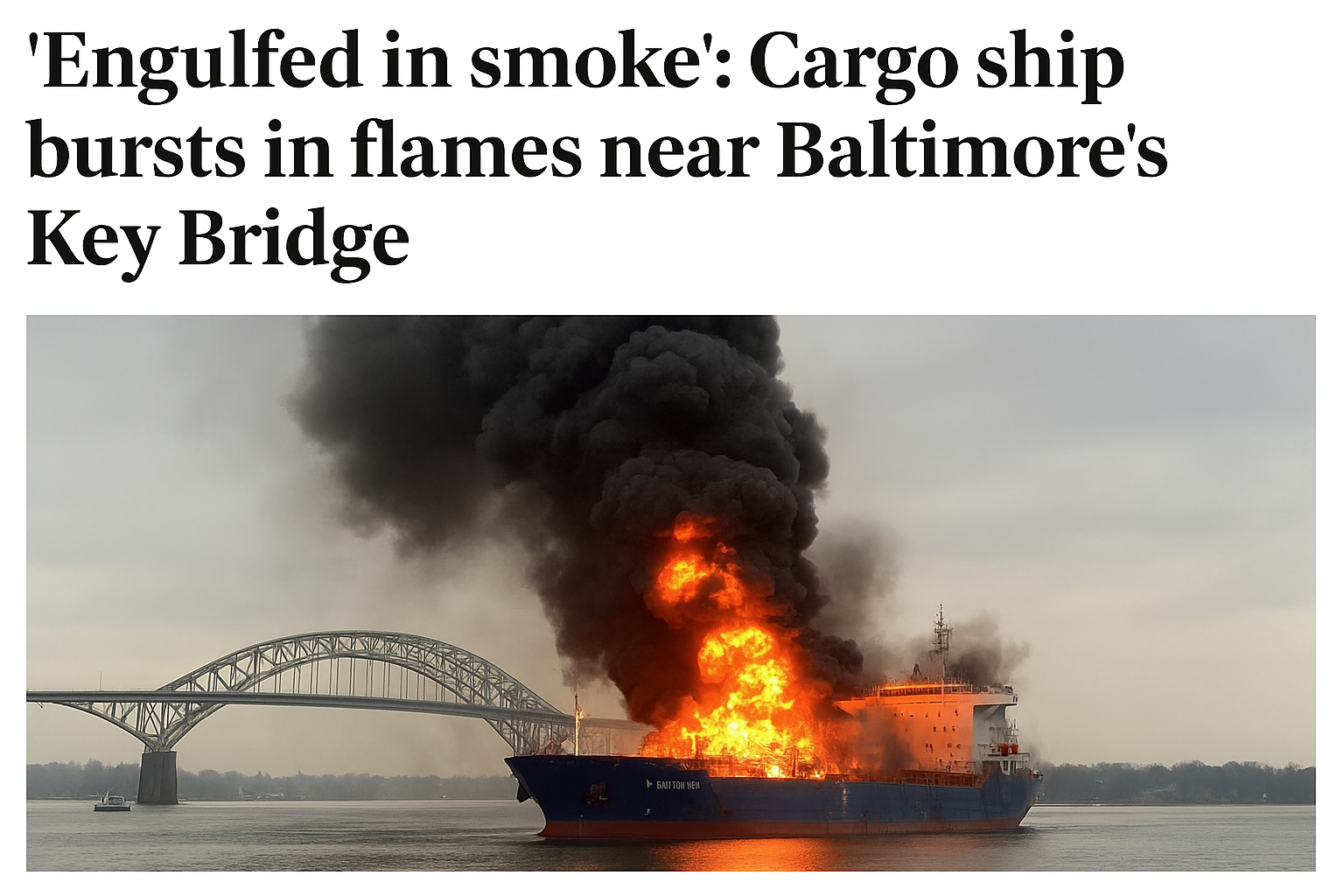
On Monday evening, August 18, 2025, around 6:45 p.m. local time, a Liberian-flagged coal cargo ship, W-Sapphire, suddenly erupted in flames near the site of the collapsed Francis Scott Key Bridge in Baltimore. Eyewitnesses reported hearing a loud explosion moments before the vessel was engulfed in thick black smoke rising over the Patapsco River. Fortunately, all 23 crew members and two pilots were safely evacuated without injury. The U.S. Coast Guard and Baltimore Fire Department quickly established a 2,000-yard safety zone, temporarily halting vessel traffic in the busy Fort McHenry Federal Channel, before reopening it after safety inspections.
Vessel and Cargo
The W-Sapphire is a 751-foot Liberian-flagged bulk carrier built in 2012. At the time of the incident, the ship carried coal, a commodity that poses unique hazards due to:
-
Self-heating potential during long voyages
-
Gas accumulation that may ignite explosively
-
Dust explosions in confined spaces
The vessel had 23 crew members and 2 local pilots, all of whom were safely evacuated with no injuries reported.
Location Sensitivity
The blast site holds symbolic and operational importance. It is adjacent to the remains of the Francis Scott Key Bridge, which collapsed in March 2024 after the container ship Dali struck a support pier. That disaster killed six workers and froze port traffic for weeks.
Since then, the area has been under strict monitoring with reconstruction work underway. The replacement Key Bridge is projected to be completed by 2028 at a cost of $1.7–$1.9 billion.
Emergency Response
The rapid response showcased preparedness developed since the 2024 bridge collapse:
-
Coast Guard & Baltimore Fire established a 2,000-yard safety zone.
-
Firefighting teams contained the blaze within the ship.
-
Sonar-equipped vessels scanned for underwater debris (including the blown-off hatch).
-
By August 19, the channel was declared safe and commercial traffic resumed, preventing long-term disruption.
Possible Causes (Under Investigation)
While the official cause is pending investigation, experts suggest:
-
Coal self-heating in the hold, creating flammable gases.
-
Gas and dust accumulation leading to a confined explosion.
-
Mechanical/electrical fault in or near cargo compartments.
-
Over-pressure blast causing the hatch failure.
Authorities will confirm findings once the Coast Guard and investigators complete assessments.
Operational & Economic Impact
-
Channel closure: Short-lived; less than 24 hours.
-
Environmental risk: No confirmed oil spill or coal leakage.
-
Trade continuity: Channel reopening on Aug 19 minimized impact on regional supply chains.
-
Port resilience: Response efficiency contrasted with the prolonged disruption after the 2024 Key Bridge collapse.
Lessons Learned & Implications
-
Cargo Monitoring: Bulk carriers transporting coal need rigorous pre-sail checks (temperature, gas monitoring, ventilation).
-
Emergency Preparedness: Quick imposition of safety zones and sonar deployment reduced risks.
-
Infrastructure Vulnerability: Maritime incidents near critical bridges or reconstruction sites carry amplified risks.
-
Regulatory Outlook: Authorities may tighten stowage, ventilation, and inspection requirements for coal shipments.
Conclusion
The August 18, 2025, W-Sapphire explosion was a dramatic but fortunately non-fatal incident. The rapid and effective response ensured no casualties, no environmental impact, and only minor disruption to Baltimore’s shipping lanes.
It serves as a stark reminder of the hazards of bulk cargo shipping and the critical need for strict monitoring and robust response systems, especially near sensitive infrastructure like the Key Bridge reconstruction zone.
While investigations continue, the event underscores both the risks of combustible cargoes and the resilience of port emergency management. Lessons learned here will guide future safety protocols, ensuring safer operations in Baltimore and beyond.


