
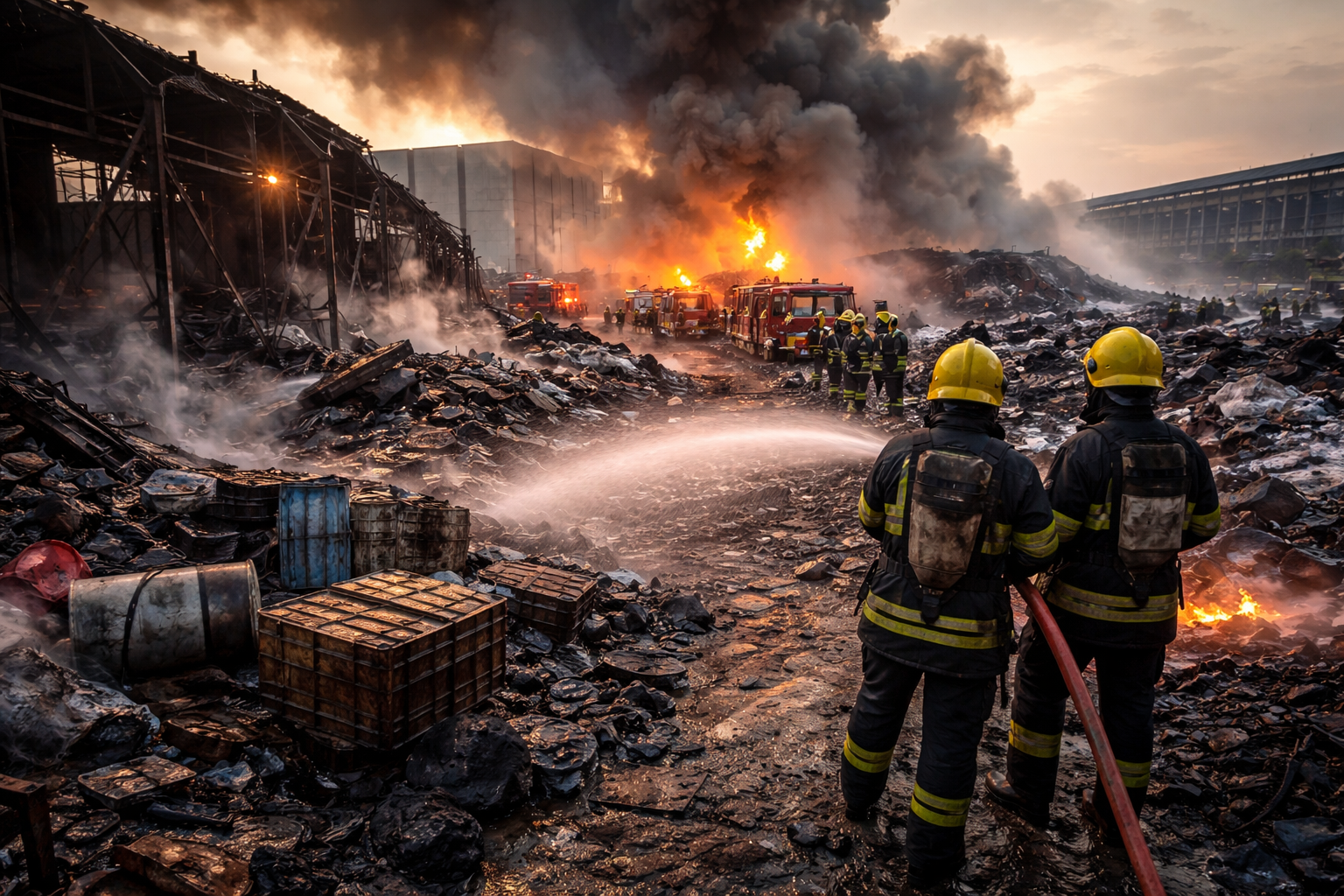
A single spark can bring an entire industrial operation to a halt—causing financial loss, legal consequences, and most importantly, risking lives. In this industrial fire case study India, we dive into real incidents that reveal how small negligence can lead to massive disasters. This industrial fire case study India highlights critical gaps in safety preparedness and exposes recurring failures across industries. By understanding these real-world scenarios through this industrial fire case study India, businesses can take proactive steps to avoid becoming the next headline.
Case Study 1: Warehouse Fire in Bhiwandi, Maharashtra
Bhiwandi, known as a major logistics hub, has witnessed several warehouse fires over the years. In one major incident, a fire broke out in a storage facility due to an electrical short circuit.
What Happened?
The fire started late at night when the facility was minimally staffed. Within minutes, highly combustible stored goods fueled the flames, leading to rapid fire spread.
Key Issues Identified:
- Overloaded electrical systems
- Poor wiring maintenance
- Lack of early fire detection systems
- Absence of trained emergency response staff
This fire incident case study India clearly shows how negligence in electrical maintenance can lead to large-scale destruction.
Case Study 2: Chemical Factory Fire in Ankleshwar, Gujarat
Ankleshwar, one of India’s largest industrial zones, reported a serious fire in a chemical manufacturing unit.
What Happened?
The fire was triggered by a chemical reaction that went out of control, leading to an explosion and subsequent fire.
Key Issues Identified:
- Improper storage of hazardous chemicals
- Lack of real-time monitoring systems
- Inadequate fire suppression mechanisms
- Poor safety protocol enforcement
This case highlights the dangerous nature of industrial fire hazards and causes, especially in chemical industries.
Common Patterns Observed Across Incidents
After analyzing multiple incidents, a pattern clearly emerges:
- Electrical faults remain one of the leading causes
- Storage of flammable materials without safety planning
- Delayed detection and response
- Lack of compliance with fire safety norms
These recurring issues underline the importance of proactive safety measures, especially in warehouse fire safety India, where fire loads are extremely high.
Lessons Learned & Prevention Strategies
To avoid such disasters, industries must adopt proactive measures:
- Conduct regular fire audits and risk assessments
- Install advanced fire detection and suppression systems
- Ensure proper electrical maintenance
- Train employees for emergency response
- Follow strict compliance with fire safety norms
These are not optional—they are essential fire prevention strategies for industries that directly impact lives and business continuity.
Expert Insight: The Role of Professional Fire Safety Services
Real-world incidents prove that relying only on basic precautions is not enough. Industries need expert guidance, advanced systems, and regular audits to stay protected.
Implementing effective fire prevention strategies for industries—such as automated suppression systems, risk assessments, and compliance checks—can drastically reduce fire risks and potential losses.
Conclusion
Industrial fires don’t happen overnight—they are the result of ignored warnings, poor planning, and lack of accountability. This analysis of recent incidents shows that most disasters could have been prevented with the right approach. Businesses must stop treating fire safety as a formality and start viewing it as a critical investment.
Learning from every industrial fire case study India is the only way forward. Because in fire safety, one mistake is all it takes to turn years of hard work into ashes.


